
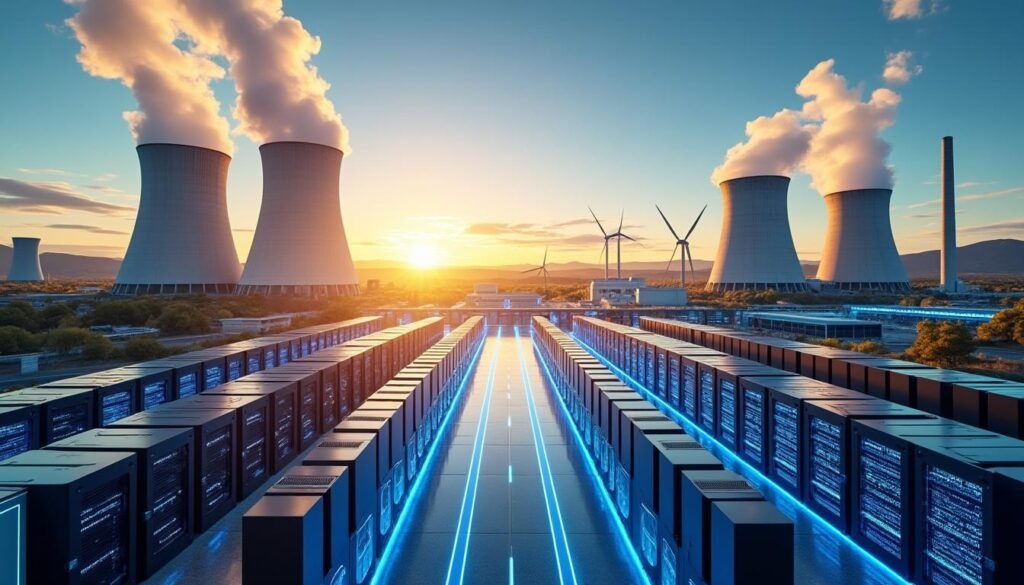

The dawn breaks early on the outskirts of Abilene, Texas, but the day is already in full swing. A line of cars stretches for a mile, a daily pilgrimage for the thousands of workers erecting a monument to the new age of artificial intelligence. This is Stargate, a $500 billion program designed to build the colossal infrastructure AI demands. The Abilene site alone will span 4 million square feet, the equivalent of 70 football fields, and house eight buildings packed with up to 50,000 Nvidia AI chips each. Its thirst for power is staggering, approaching 1.2 gigawatts—rivaling the output of a conventional nuclear plant. This isn’t just another construction project; it’s a test of how to organize madness on an unprecedented scale. The exponential growth of AI has created an energy dilemma that is reshaping global power strategies.
This insatiable demand for electricity is forcing tech giants to think beyond traditional power grids, which are already strained. The race is on to find clean, reliable, and scalable energy sources capable of powering the future 24/7. The solution isn’t a single silver bullet but a portfolio of audacious technologies once relegated to the fringes. Industry leaders are now making massive bets on advanced nuclear energy, specifically Small Modular Reactors (SMRs), and tapping into the planet’s own heat through enhanced geothermal systems. These are not just power sources; they are foundational pillars for the next decade of technological advancement. The challenge is twofold: generate immense power sustainably and build the infrastructure to house it faster than ever before. To solve it, companies are adopting revolutionary construction techniques and forging new global alliances, rewriting the playbook for megaproject execution.
The New Blueprint for AI Megaprojects
Building a data center the size of a small city requires more than just concrete and steel; it demands a radical approach to planning and execution. At the Abilene site, many of the thousands of workers are new to projects of this magnitude. To bridge the experience gap and streamline the immense complexity, teams are turning to 4D construction planning. Using platforms like Bentley’s SYNCHRO, they link intricate 3D models directly to construction schedules. This creates a living digital twin of the project, allowing stakeholders to visualize every phase and sequence of the build before a single foundation is poured.
This technology is more than just a visualization tool; it’s an essential part of onboarding a new labor force. For a worker who has never built on this scale, the 4D model paints a crystal-clear picture of their scope of work, reducing errors and increasing efficiency. This level of foresight is crucial when coordinating a project where delays can cost millions and impact the global rollout of new AI services. It’s a strategy focused on de-risking the entire venture from the ground up, starting with a comprehensive understanding of everything from subsurface geology to the final placement of server racks.
Nuclear Energy Adopts a Startup Mentality
To meet the relentless need for power, the tech industry is looking at nuclear energy with fresh eyes. The traditional, decade-long process of building massive nuclear plants is simply too slow for the pace of AI. The solution comes in the form of Small Modular Reactors, or SMRs. David Lawson of Assystem, a top nuclear engineering firm, calls it “the Henry Ford approach to nuclear power plants.” SMRs are designed with standardized, prefabricated components that can be manufactured in a factory and assembled on-site, drastically cutting down construction time and cost.
This modularity is a game-changer for an industry that needs reliable baseload power with an uptime of 95% or more. Unlike solar and wind, which are intermittent, nuclear provides the continuous, predictable energy that data centers crave. As these SMRs are deployed, security becomes paramount. Innovators are even exploring concepts borrowed from blockchain, like “trustlessness,” to create decentralized, tamper-proof security systems. By distributing control across thousands of nodes, the infrastructure’s data integrity can be secured without relying on a single, vulnerable central entity. This novel approach reflects how tech giants are investing in nuclear power to secure their energy future.
Geothermal: Tapping the Earth’s Internal Fire for AI
While nuclear offers immense power, another, quieter energy revolution is happening right beneath our feet. Geothermal energy, long considered a niche player, is emerging as a powerful and highly efficient solution for AI data centers. A groundbreaking study by Project InnerSpace reveals that a first-of-a-kind geothermal project could deliver energy at a competitive $88 per MWh. With continued investment and learning-curve effects, that cost could drop into the $50–$60 per MWh range by 2035, making it cheaper than new natural gas plants.
What makes geothermal particularly compelling is its dual-use capability. It doesn’t just generate electricity; it can also provide cooling, a massive energy drain that can account for up to 40% of a data center’s total consumption. By using excess geothermal thermal energy for direct cooling, operators could save over $3 billion over 30 years on a single large-scale facility. This completely changes the economic equation for site selection and facility design. The United States alone has an estimated 3,400 GW of accessible geothermal potential, far exceeding the projected demand from data centers. Moreover, the industry offers a smooth transition for workers, as around 80% of the skills from the oil and gas sector are directly transferable to geothermal development. The potential has become so clear that geothermal energy is rapidly gaining ground in AI power strategies.
A Global Shift in Energy Strategy
This race to power AI is not just a U.S. phenomenon; it’s a global strategic shift. Nations around the world are recognizing that digital infrastructure requires a new energy paradigm. In Indonesia, state-owned energy companies are developing roadmaps for geothermal-powered “green data centers.” In Europe, more than 20 industry organizations are pushing for an EU Geothermal Action Plan, expected in early 2026, to unlock advanced geothermal technologies across the continent. Project InnerSpace has already launched GeoMap Europe, a platform that aggregates subsurface data to pinpoint prime locations for development.
From Germany fast-tracking geothermal plant legislation to new projects emerging in Latin America and East Africa, the message is clear. The conversation has evolved, with data centers now seen as anchor customers capable of underwriting and accelerating new geothermal and nuclear development. This mirrors the role they played in making wind and solar power purchase agreements mainstream, but this time with firm, always-on energy sources. It highlights how Big Tech has quietly become the world’s biggest energy customer, driving innovation across the entire sector.
- Dual-Use Efficiency: Geothermal provides both electricity and direct cooling, drastically reducing operational costs for AI facilities.
- Massive Resource Potential: The U.S. alone has thousands of gigawatts of untapped geothermal energy, enough to power the AI boom for decades.
- Workforce Compatibility: The geothermal industry can readily absorb skilled labor from the oil and gas sector, facilitating a smoother energy transition.
- Global Scalability: Momentum for geothermal and SMRs is building across Europe, Asia, and Africa, creating a worldwide market for these technologies.
- Economic Viability: With continued investment and policy support, both geothermal and modular nuclear are on a trajectory to become more cost-effective than fossil fuels.
This strategic pivot is essential, not only to power the current AI arms race between players like AWS, Azure, and GCP, but also to build a sustainable foundation for the technologies of tomorrow.
Why can’t we just use solar and wind to power AI data centers?
Solar and wind are intermittent energy sources, meaning they don’t generate power 24/7. AI data centers require ‘baseload’ power, a constant and reliable supply of electricity to run their operations continuously. While renewables are part of the solution, they need to be paired with firm power sources like nuclear or geothermal to guarantee 95%+ uptime.
What are Small Modular Reactors (SMRs)?
Small Modular Reactors are advanced nuclear reactors that are much smaller than conventional ones. Their key advantage is modularity; their components are manufactured in a factory and assembled on-site. This ‘Henry Ford approach’ makes them faster and cheaper to build, providing a scalable solution for power-hungry data centers.
How does geothermal energy also provide cooling?
Geothermal systems extract heat from the earth to generate electricity. This process also involves moving thermal energy, which can be harnessed for direct cooling. Instead of using energy-intensive traditional chillers, data centers can use the geothermal loop to dissipate heat, significantly reducing their overall power consumption and operational costs.
Are these new energy solutions being deployed globally?
Yes, this is a global trend. While the U.S. has several high-profile projects, countries in Europe, Asia, Latin America, and Africa are actively developing their geothermal and nuclear capabilities. Data centers are increasingly seen as ‘anchor customers’ that can help finance and accelerate the deployment of these next-generation energy projects worldwide.