
For decades, Closed-Circuit Television (CCTV) has been the silent guardian of physical retail spaces. It has served as a fundamental tool for security, a reactive resource for reviewing incidents after they occur. Yet, this traditional approach leaves a vast amount of visual data untapped, offering little more than a passive record. Retailers face persistent challenges with operational inefficiencies, unexplained inventory shrinkage, and a growing gap in understanding in-store customer behavior, issues that raw video footage alone cannot solve.
This reliance on a reactive system means opportunities are constantly missed. Staffing levels are based on historical trends rather than real-time demand, leading to long queues and frustrated customers. Promotional displays are placed with intuition rather than data, their true impact remaining a mystery. The potential to transform this passive surveillance into a proactive source of business intelligence has remained just out of reach. Now, by pairing existing camera hardware with AI-enabled computer vision, retailers are finally turning static video into a dynamic stream of actionable insight, revolutionizing every facet of the in-store experience.
From passive surveillance to proactive business intelligence
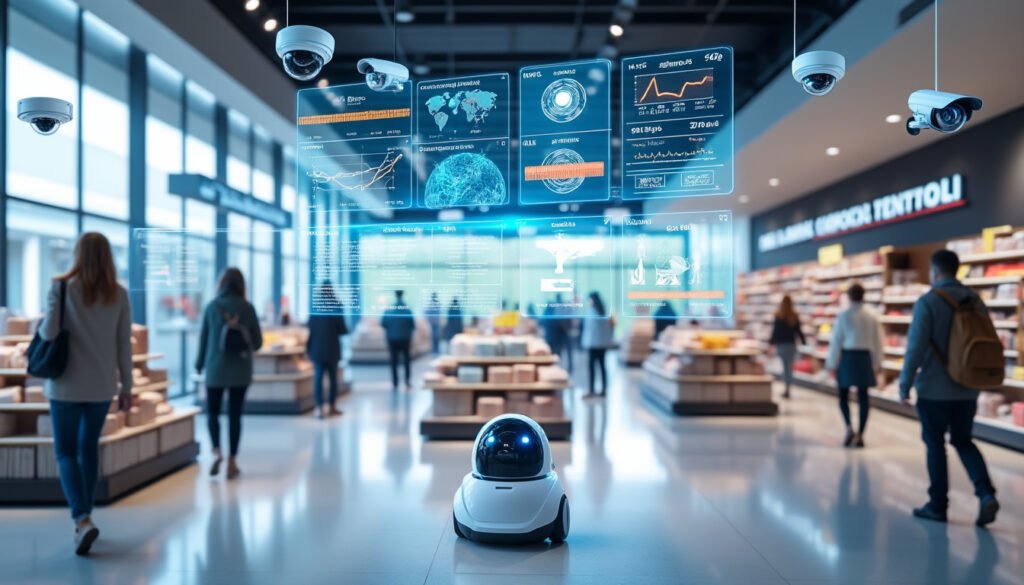
The evolution of in-store cameras marks a significant shift from a single-purpose security function to a multi-faceted strategic asset. AI-driven visual data is providing physical stores with capabilities once exclusive to the world of e-commerce. By analyzing video streams in real time, these intelligent systems identify patterns in customer movement, measure product engagement, and calculate dwell times with remarkable accuracy.
This transformation allows retailers to make informed, data-driven decisions that directly impact their bottom line. Heatmaps, for example, can visualize exactly where customers spend the most time, revealing high-traffic zones, navigational bottlenecks, or underperforming areas. Armed with this knowledge, managers can optimize store layouts to streamline the customer journey, reduce congestion, and ensure key products receive maximum exposure. This analytical power turns every corner of the store into a measurable data point.
How AI vision streamlines operations and enhances security
Beyond customer analytics, AI vision offers powerful tools to refine daily operations and bolster security. Staffing levels can be optimized in real time, with the system allocating resources based on current foot traffic patterns rather than historical estimates. This ensures employees are deployed precisely where they are needed most, improving service and efficiency. Queue management systems can automatically detect when checkout lines become too long, triggering alerts for staff to open additional tills and reduce customer wait times.
On the security front, the technology moves beyond simple theft recording to intelligent loss prevention. AI algorithms can identify suspicious behaviors associated with shoplifting and send real-time alerts to in-store personnel or a central Security Operations Centre (SOC). This proactive approach allows for immediate intervention. Furthermore, smart cameras can monitor shelf inventory, sending notifications when stock levels are low to prevent lost sales from out-of-stock items. These systems support employees by automating routine tasks, freeing them to focus on higher-value, customer-facing interactions.
Unlocking data-driven marketing and superior customer experiences
Visual sensor data provides an unprecedented method for measuring the performance of in-store marketing campaigns. Retailers can now accurately assess how customers interact with promotional displays or new product launches. If a particular arrangement garners significant attention but fails to convert into sales, these insights can guide immediate adjustments for more effective merchandising strategies. This feedback loop, once difficult to capture outside of online platforms, is now available in the physical world.
This technology also directly elevates the customer experience. By analyzing movement patterns, retailers can identify and rectify areas where accessibility could be improved, such as widening aisles for better flow. In-store advertising is also becoming more dynamic. Digital signage can be programmed to adapt its messaging based on real-time data, triggering relevant promotions as customers interact with specific products. This fusion of digital responsiveness and physical presence creates a more personalized and seamless shopping journey for every visitor. The underlying technology, closely related to advanced vision-language models, is what makes this contextual understanding possible.
| Capability | Traditional CCTV | AI-Powered Vision |
|---|---|---|
| Security | Reactive (post-incident review) | Proactive (real-time threat detection) |
| Operations | Manual observation only | Automated queue and stock management |
| Customer Insights | None | Heatmaps, dwell time, path analysis |
| Marketing ROI | Difficult to measure | Direct measurement of in-store campaign engagement |
The ethical imperative: balancing innovation with privacy
As retailers increasingly rely on AI, the importance of ethical implementation cannot be overstated. Building and maintaining trust with customers requires a commitment to responsible and transparent AI practices. This includes providing clear explanations of what data is being collected and how it is being used, combined with robust data governance and cybersecurity protocols to protect sensitive information.
Advanced retail video analytics platforms are designed with privacy at their core. Many vision AI systems operate on a “need-to-know” basis, monitoring behaviors while automatically redacting or blurring personally identifiable information to protect customer privacy. By prioritizing ethics and adhering to regulatory compliance, retailers can mitigate risks and foster long-term loyalty. It is also critical to remember that these tools are designed to enhance, not replace, human oversight, as human judgment remains essential for navigating nuanced customer interactions.
The future of retail: sensor fusion and predictive analytics
The integration of AI, video analytics, and cloud computing is charting a new course for retail intelligence. Looking toward the near future, the use cases are evolving rapidly from simple optimization to predictive analysis. The next frontier is sensor fusion, a process that combines different data streams—such as merging video with audio analytics—to gain richer, more detailed insights into store operations and customer behavior.
This layered data approach will enable smarter, real-time decision-making on an unprecedented scale. It marks a fundamental shift in how physical retail spaces are understood, managed, and improved. By transforming visual inputs into predictive business intelligence, retailers can unlock new efficiencies and create experiences that rival the personalization of online shopping. This embrace of technology is what will separate the leaders from the laggards in an increasingly competitive market, especially as discussions around global AI governance mature.
Can AI vision systems be integrated with my existing CCTV hardware?
Yes, many modern AI vision platforms are designed to be hardware-agnostic. They can seamlessly integrate with existing camera infrastructure, allowing retailers to leverage their current investments while upgrading their analytical capabilities without a complete hardware overhaul.
How is customer privacy protected with this technology?
Privacy is a primary design consideration. Advanced systems use techniques like on-device processing (edge computing) to analyze video without sending raw footage to the cloud. Furthermore, features such as automatic facial redaction and the anonymization of data ensure that personal identities are protected while still providing valuable behavioral insights.
What is the typical return on investment (ROI) for implementing AI video analytics?
The ROI can be realized through multiple channels. Key benefits include a measurable reduction in shrinkage and theft, improved operational efficiency through optimized staffing and queue management, and increased sales from better product placement and campaign performance. Many retailers report seeing a positive ROI within months of deployment.
Does this technology require a dedicated in-house IT team to manage?
Not necessarily. Many AI vision solutions are offered as a cloud-based service (SaaS), which simplifies deployment and maintenance. These platforms often come with intuitive dashboards and automated alerting, minimizing the need for constant management and allowing store managers to focus on acting on the insights provided.