
The journey toward fully autonomous vehicles is one of the most compelling technological narratives of our time. While progress in robotaxis and Level 3 features is evident, the path to full autonomy remains fraught with challenges related to safety, regulation, and public trust. At the heart of this complex endeavor lies computer vision, a field of artificial intelligence that enables machines to interpret and understand the visual world. It is this technology, above all others, that continues to define the pace and potential of self-driving progress.
Unlike other sensors like LiDAR or radar, which excel at measuring distance and velocity, cameras provide rich, high-resolution data that mirrors human sight. This visual information is crucial for identifying and classifying objects with the nuance required for navigating unpredictable real-world environments. From reading traffic signs to distinguishing a pedestrian from a lamppost, computer vision forms the perceptual bedrock upon which all subsequent driving decisions are made. The central question is no longer if autonomous driving will happen, but how its remaining obstacles will be overcome.
The Core Perceptual Tasks of an Autonomous Vehicle
An autonomous vehicle’s ability to “see” is not a single function but a symphony of interconnected processes. The system must continuously analyze a stream of visual data to build a comprehensive, real-time understanding of its surroundings. This is where the foundational techniques of computer vision come into play, each solving a specific piece of the perceptual puzzle.
This complex interpretation of visual data is what allows the vehicle to move beyond simple sensor readings and begin to understand its environment contextually. The evolution of these capabilities is rapid, with new approaches constantly emerging that improve accuracy and efficiency. In fact, many believe vision-language models are poised to redefine the field entirely.
From Object Detection to Full Scene Understanding
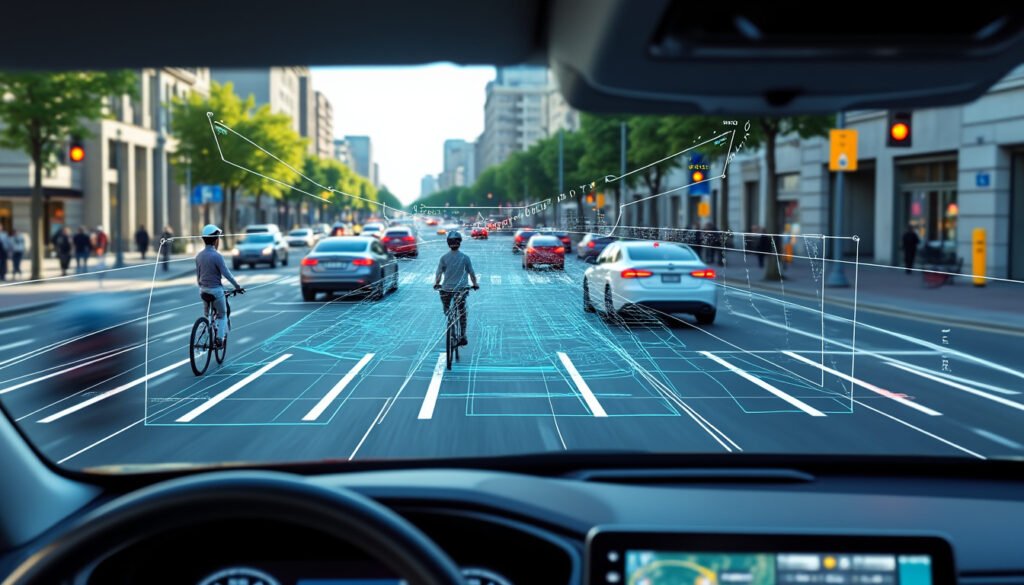
The most fundamental task is object detection, which involves identifying and locating objects like other cars, cyclists, and pedestrians within the camera’s feed. Modern systems use deep learning models such as YOLO (You Only Look Once) or SSD (Single Shot MultiBox Detector) to perform this task with remarkable speed and accuracy.
Beyond simply identifying objects, semantic segmentation assigns a class label to every single pixel in an image. This process effectively paints a detailed map of the environment, distinguishing the road from the sidewalk, lane markings from crosswalks, and sky from buildings. This granular understanding is vital for precise path planning and safe navigation, especially in cluttered urban settings.
Navigating the Hurdles of Real-World Deployment
Despite significant advancements, deploying reliable computer vision systems at scale presents immense challenges. The primary difficulty lies in handling “long-tail events”—rare and unpredictable scenarios that are not well-represented in training data. These can range from unusual road debris to complex, multi-vehicle accidents in progress.
Furthermore, performance can degrade significantly under adverse conditions. Heavy rain, snow, fog, and the glare of direct sunlight can obscure camera lenses and alter the appearance of objects, confusing the perception system. Ensuring consistent and reliable operation in all weather and lighting conditions remains a major focus of research and development. The diverse applications of computer vision in autonomous driving are constantly being tested against these real-world limits.
The Critical Balance Between Performance and Efficiency
A self-driving car’s computer vision pipeline must process vast amounts of data in real-time to make split-second decisions. This necessitates highly efficient algorithms that can run on specialized, power-constrained onboard hardware. Optimizing these systems involves a delicate trade-off between computational expense and predictive accuracy.
To achieve this, developers leverage hardware acceleration with GPUs and employ lightweight deep learning models. They also focus on best practices such as using diverse, high-quality, and well-annotated data for training models to avoid overfitting to specific conditions. This constant push for optimization draws parallels with advancements seen in other fields, such as the increasing efficiency of industrial robotics.
| Vision Technique | Primary Function | Key Challenge | Common Model/Algorithm |
|---|---|---|---|
| Object Detection | Identify and locate objects (cars, people) | Handling small or occluded objects | YOLO, Faster R-CNN, SSD |
| Semantic Segmentation | Classify every pixel in an image (road, sky) | Achieving real-time processing speeds | U-Net, DeepLab |
| Lane Detection | Identify lane markings on the road | Faded markings and poor weather | Hough Transform, Deep Learning-based methods |
| Optical Flow | Estimate the motion of objects between frames | Computational intensity and accuracy | Gunnar Farnebäck’s algorithm, FlowNet |
The Path Forward: Testing, Validation, and Security
To earn public trust and regulatory approval, autonomous systems must be subjected to exhaustive testing and validation. This process goes far beyond driving millions of miles on public roads. It involves rigorous unit testing of individual components, such as the object detector or lane tracker, and extensive integration testing in simulated environments.
These simulations allow developers to create and test against millions of virtual scenarios, including the dangerous edge cases that are impractical or impossible to replicate in the real world. By validating results against ground truth data and established performance metrics, engineers can systematically identify and resolve weaknesses in the system.
Securing the Eyes of the Vehicle
As vehicles become more connected and reliant on software, cybersecurity becomes a paramount concern. The computer vision system, being a primary input for decision-making, is a potential target for malicious attacks. An attacker could theoretically use adversarial examples—subtly altered images designed to fool a neural network—to make a car misidentify a stop sign or fail to see a pedestrian.
Mitigating these risks involves a multi-layered security approach. This includes validating all data inputs, using secure protocols for any data transmission, and implementing methods to verify the integrity of machine learning models before they are loaded. As explored in various research papers on computer vision applications, building a robust and secure system is as important as building an accurate one.
Why is computer vision more important for self-driving cars than LiDAR or radar?
While LiDAR and radar are excellent for measuring distance and velocity, they lack the ability to provide rich, contextual information. Computer vision, through cameras, allows the car to read text (like on traffic signs), identify colors (like traffic lights), and understand the nuanced visual cues of the road, making it indispensable for comprehensive environmental perception.
What are ‘edge cases’ in autonomous driving and why are they a problem?
Edge cases, or long-tail events, are rare and unpredictable situations that a self-driving car might encounter. Examples include unusual objects on the road, complex accident scenes, or erratic human behavior. They are a problem because it is nearly impossible to include every possible scenario in a model’s training data, so the system must be robust enough to handle novelty safely.
How do self-driving cars work in bad weather like heavy rain or snow?
Bad weather is a significant challenge. To cope, autonomous systems use a technique called sensor fusion, combining data from cameras, radar, and LiDAR. Radar can penetrate rain and snow to detect objects, complementing the camera’s visual data which may be obscured. Advanced algorithms are also used to digitally ‘clean up’ noisy images and improve detection in poor visibility.
Can a self-driving car’s vision system be hacked?
Yes, it is a theoretical possibility. Researchers have demonstrated ‘adversarial attacks’ where subtly manipulated images can trick an AI into misclassifying an object. To prevent this, manufacturers are developing robust security measures, including input validation, model integrity checks, and secure over-the-air update protocols to protect the system from tampering.