
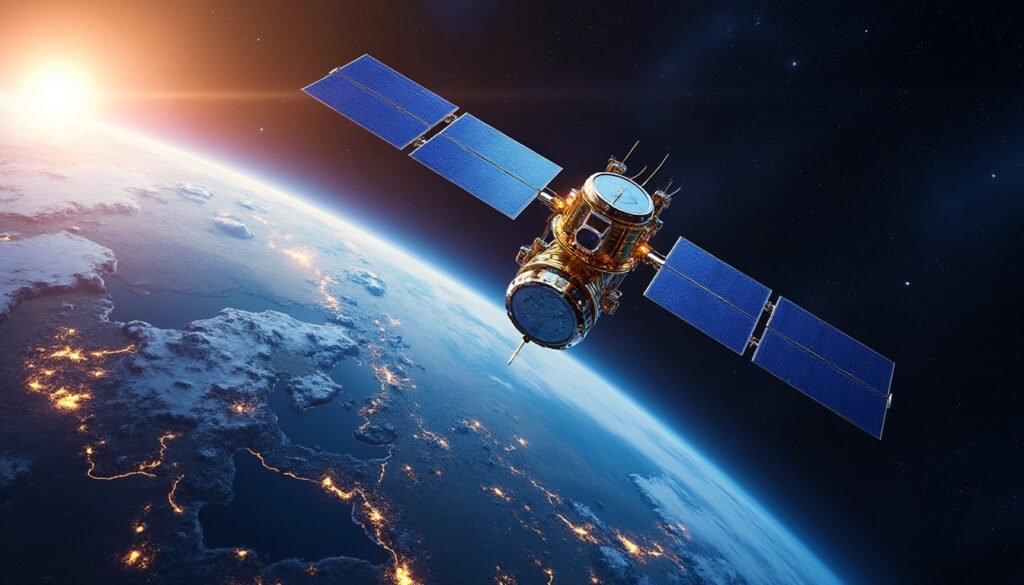

We live under the illusion of a fully connected planet. From our bustling cities, it feels like data flows as freely as air, yet this is a convenient fiction. While cellular networks reach roughly 90% of the global population, they cover a mere 15% of the Earth’s surface. This leaves a staggering 90% of our world—oceans, deserts, mountains, and polar regions—in a digital shadow, a challenge amplified by the phasing out of older 2G and 3G networks.
For industries operating in these remote territories—agriculture, logistics, energy, and conservation—this connectivity gap isn’t an inconvenience; it’s a critical barrier to efficiency, safety, and innovation. How can you track a shipping container across the Pacific, monitor soil moisture in a vast rural farm, or protect endangered species in a remote national park without a reliable signal? The answer lies not on the ground, but in the sky, with the convergence of terrestrial and satellite networks.
Bridging the great digital divide with non-terrestrial networks
The solution materializing to fill this void is the Non-Terrestrial Network (NTN). NTNs are sophisticated radio communication systems that operate far above the Earth’s surface, leveraging a constellation of satellites, high-altitude platforms, and even drones. Instead of relying on ground-based radio masts, these networks transmit data directly from an IoT device to a satellite, effectively turning the sky into one massive cell tower.
This leap forward is enabled by the integration of NTN technology directly into the 3GPP cellular standards, the very foundation of 5G. In the past, connecting to a satellite required specialized, often bulky and expensive, hardware. Now, the paradigm is shifting. By 2026, we are seeing the widespread adoption of devices that can seamlessly switch between a terrestrial 5G network and a satellite connection without any user intervention. If a ground signal fails, the NTN provides an uninterrupted link, a feature of paramount importance for critical infrastructure.
This integration means an IoT device with an NTN-enabled SIM card can automatically roam onto a satellite network using its existing cellular plan. The core network structures remain the same, ensuring a smooth transition for businesses and developers. The main trade-offs are higher latency and lower bandwidth compared to terrestrial 5G, but for the vast majority of IoT applications sending small data packets, this is a more than acceptable compromise for achieving true global reach.
The orbital dance: LEO vs. GEO satellites explained
To meet diverse needs, NTN architecture employs two primary types of satellite systems: Geostationary Earth Orbit (GEO) and Low Earth Orbit (LEO). The choice between them is a delicate dance of distance, speed, and power, dictated entirely by the application’s requirements.
GEO satellites are the titans of the sky, positioned at an altitude of approximately 36,000 kilometers. From this vantage point, they remain stationary over a single region of the Earth, providing constant and predictable coverage. However, this immense distance results in high latency and requires more power from the device on the ground. Their low data rates (around 2-4 kbps) make them perfect for low-frequency, critical communications like emergency alerts or alarm systems where reliability trumps speed.
Conversely, LEO satellites operate in a swarm much closer to home, at altitudes between 600 and 800 kilometers. This proximity allows for significantly lower latency, higher data rates (20-40 kbps), and reduced power consumption, making them ideal for the majority of IoT use cases. Because these satellites move rapidly across the sky, a “store-and-forward” architecture is often used, where data is collected and relayed as the satellite passes over a ground station. This system is perfect for routine data collection, such as monitoring agricultural sensors or tracking shipping assets.
Real-world impact: satellite IoT applications are transforming industries
The promise of ubiquitous connectivity is unlocking powerful new efficiencies across sectors that have long been hampered by the lack of data. The convergence of 5G and satellite networks ensures that critical data packets are no longer lost to dead zones, fostering a new age of IoT where insights are continuous and reliable.
Consider the following transformations:
- Smart Agriculture: Farmers can now deploy sensors across thousands of acres to monitor soil health, water levels, and crop conditions in real-time. This data allows for precision irrigation and resource management, maximizing yields while minimizing waste, even in the most remote farmlands.
- Global Asset Tracking: Logistics companies can maintain constant visibility of their valuable assets, whether it’s a shipping container in the middle of the ocean or a fleet of vehicles in a desert. This prevents misplacement, theft, and damage, creating a more resilient global supply chain.
- Environmental Conservation: Satellite IoT is a game-changer for monitoring wildlife and sensitive ecosystems. Conservation asset tracking solutions allow researchers to follow animal migration patterns and protect against poaching in vast, inaccessible territories, feeding crucial data into systems that can help with powering AI for climate solutions.
- Energy Infrastructure: Utility companies can remotely manage and maintain pipelines, wind turbines, and solar panels located far from urban centers. This proactive monitoring improves operational effectiveness and allows for a rapid response to any potential failures.
The technology powering global connectivity
This revolution is being driven by remarkable advancements in hardware and communication standards. A key innovation is the development of compact, power-efficient Systems-in-Package (SiP) that integrate multiple technologies into a single chip. For instance, Nordic Semiconductor’s nRF9151 module is a prime example of this trend, supporting terrestrial LTE-M/NB-IoT, DECT NR+, and satellite NTN communications in one tiny package.
With its full NTN functionality rolled out via firmware updates in late 2025, this module enables devices to have true global connectivity out of the box. These chips operate on specific frequency bands designated for NTN, primarily the n255 (L-band) and n256 (S-band), which partially overlap with terrestrial frequencies to simplify antenna design.
The emergence of new satellite providers focused solely on IoT has also been crucial. Companies like Sateliot are deploying their own constellations of CubeSats—miniaturized, cost-effective satellites—to create dedicated 5G-IoT networks in space. This is dramatically lowering the cost and complexity of satellite communications, which were once prohibitively expensive. This shift is fueling a market projected to hit nearly $15.77 billion by 2035, built on the promise of affordable, ubiquitous global networking with NTN.
How secure is data transmitted over satellite IoT networks?
Data security is a primary concern. NTN communications are protected by the same robust security protocols and encryption technologies used in terrestrial 5G networks. This ensures end-to-end encryption from the device to the cloud, safeguarding sensitive information as it travels through both satellite and ground-based infrastructure.
Will I need a special device or contract to use satellite IoT?
Initially, specialized devices or modules were required. However, the trend is moving toward integrated solutions. New IoT modules and even future smartphones are being built with NTN capabilities. For contracts, many mobile network operators are starting to offer plans that include satellite roaming, allowing a seamless switch without needing a separate subscription.
Is satellite IoT expensive compared to cellular IoT?
Historically, satellite connectivity was very expensive. However, the rise of LEO constellations and miniaturized CubeSats has drastically reduced the cost. While it may still carry a premium over standard cellular plans, the price is now low enough to provide a strong return on investment for commercial and industrial applications where terrestrial coverage is unavailable.
What is the difference between NTN-IoT and NTN-NR?
NTN-IoT is designed for standard Internet of Things use cases, like sensor data and asset tracking, which require low bandwidth. NTN-NR (New Radio) is the next evolution, designed to connect standard 5G devices like smartphones directly to satellites for services like low-speed data, voice, and messaging, effectively eliminating mobile dead zones for consumers.