
Enterprises generate vast quantities of visual data from cameras and sensors, yet struggle with the limitations of centralized processing. Sending this information to the cloud introduces latency, incurs significant bandwidth costs, and raises privacy concerns. This delay can mean the difference between catching a critical manufacturing defect and a costly product recall, or between a timely security alert and a preventable incident. The dependency on a constant, high-speed connection effectively throttles the true potential of real-time visual intelligence.
This is where a paradigm shift is occurring. By moving computation from distant data centers to the network’s edge, computer vision on the edge processes data locally, on or near the device where it is created. This approach delivers instantaneous insights, ensures operational continuity even with intermittent connectivity, and keeps sensitive data secure on-site. It represents a silent but powerful technological evolution, transforming how industries interact with the physical world.
What is edge-based computer vision?
Computer vision is a subfield of artificial intelligence that grants machines the ability to interpret and understand visual information from images and videos, much like humans do. This capability relies on deep learning algorithms, particularly convolutional neural networks (CNNs), which are designed to process visual data by analyzing it in layers. Early layers identify simple features like edges and colors, while deeper layers recognize complex objects and patterns.
When this process is executed locally on devices like smart cameras, drones, or on-premise servers, it becomes edge-based computer vision. Instead of streaming raw video to the cloud for analysis, the interpretation happens directly where the data is captured, enabling a new class of responsive and resilient applications.
The core process: from capture to action
The computer vision workflow can be distilled into four key stages. It begins with the capture of visual data by a device. This raw data is then pre-processed to enhance its quality—adjusting brightness, reducing noise, or resizing the image. The refined image is fed into an AI model that interprets its contents by identifying objects, faces, or anomalies based on its training.
Following interpretation, the system analyzes the identified patterns to understand the context. Finally, this analysis triggers an action or delivers an insight, such as halting a faulty machine, sending a security alert, or generating a report on customer traffic. Performing these steps at the edge ensures the action is immediate.
Edge versus cloud processing: a strategic comparison
Choosing between edge and cloud architectures for computer vision is not merely a technical decision; it is a strategic one with profound implications for performance, cost, and security. While the cloud offers nearly limitless computational power for training complex models, the edge excels at real-time inference where speed and reliability are paramount. This is more than just a trend; it’s part of a quiet revolution in AI that is pushing intelligence into the environments we interact with daily.
The following table outlines the fundamental trade-offs between these two deployment models, helping to clarify which approach is best suited for specific applications.
| Attribute | Edge Computer Vision | Cloud Computer Vision |
|---|---|---|
| Processing Location | On-device or local gateway | Centralized cloud servers |
| Latency | Very low (real-time response) | Higher, dependent on network speed |
| Bandwidth Usage | Low, only essential metadata transmitted | High, raw visual data is streamed |
| Privacy & Security | High, sensitive data remains on-site | Lower, data travels over public networks |
| Compute Capacity | Limited by device hardware | Virtually unlimited |
| Connectivity Reliance | Low, can operate offline | High, requires stable internet connection |
Key applications driving the on-device vision revolution
The practical benefits of edge computer vision are already manifesting across several key industries. By 2027, projections suggest that edge computing will handle the majority of computer vision workloads, a testament to its effectiveness in solving real-world challenges where immediate analysis is critical. These applications are unlocking opportunity at the edge for businesses prepared to adopt this decentralized model.
Enhancing industrial efficiency with asset monitoring
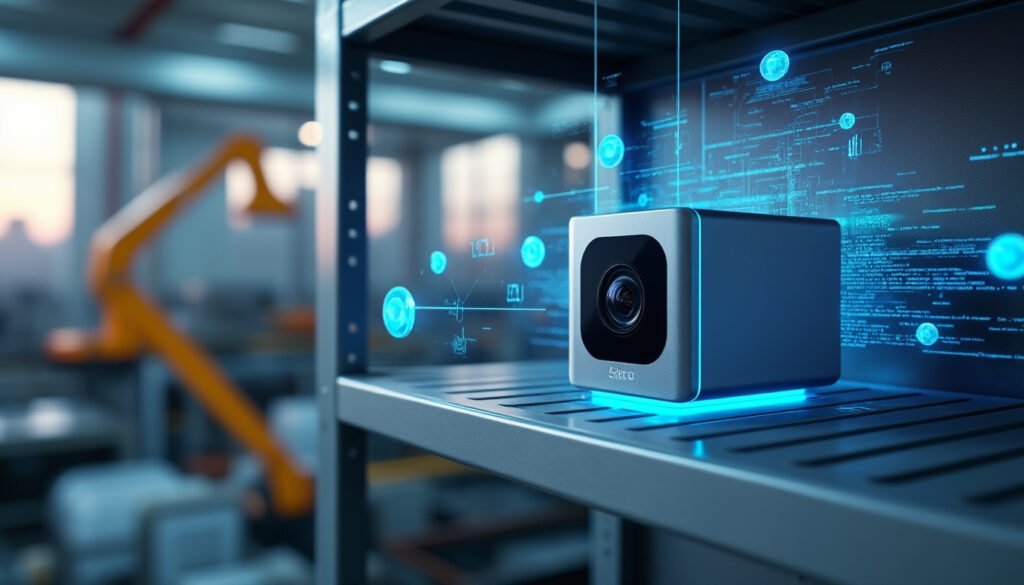
In manufacturing, edge-based cameras and sensors enable the continuous, automated monitoring of production lines. Systems like IBM’s Maximo Visual Inspection deploy models trained in the cloud to edge devices on the factory floor. These systems can detect microscopic defects, surface imperfections, or assembly errors in real time, triggering alerts that allow for immediate intervention. This capability is foundational for predictive maintenance and improving overall operational efficiency.
Redefining safety and security protocols
Computer vision at the edge significantly enhances workplace safety. It can automatically verify that workers are wearing the proper personal protective equipment (PPE) or detect environmental hazards like spills and obstructions. In public and corporate security, on-device AI can identify unauthorized access or unusual behavior without streaming sensitive footage to an external server, improving both response times and data privacy.
Optimizing spaces through real-time flow analysis
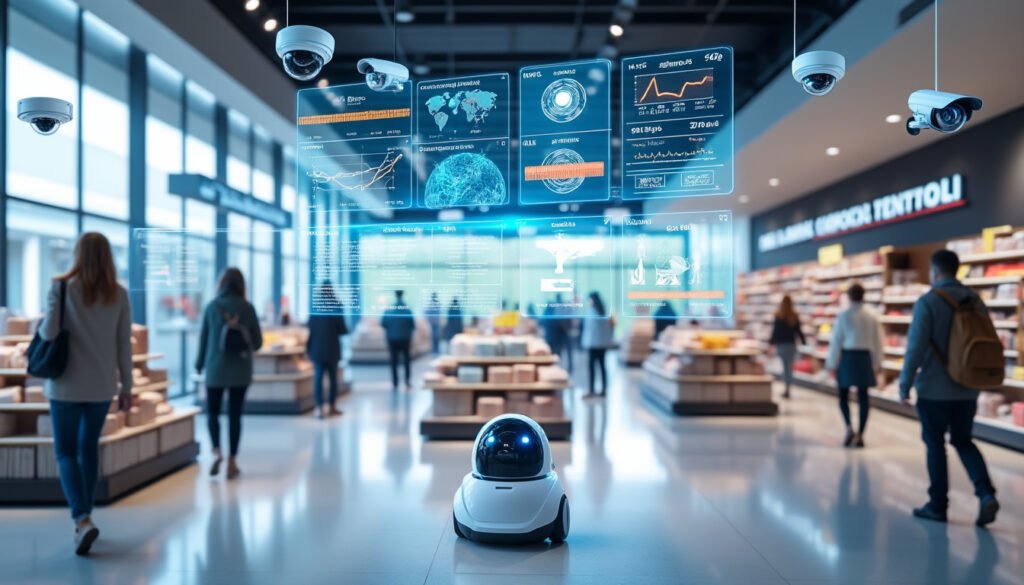
In the retail sector, understanding customer behavior is crucial. Companies like VusionGroup use edge systems to perform in-store flow analysis, tracking foot traffic and dwell times to optimize store layouts and product placements. By processing this data on-premise, retailers can make rapid adjustments to inventory and promotions, responding to customer patterns as they emerge, not hours later.
Powering the future of mobility with autonomous systems
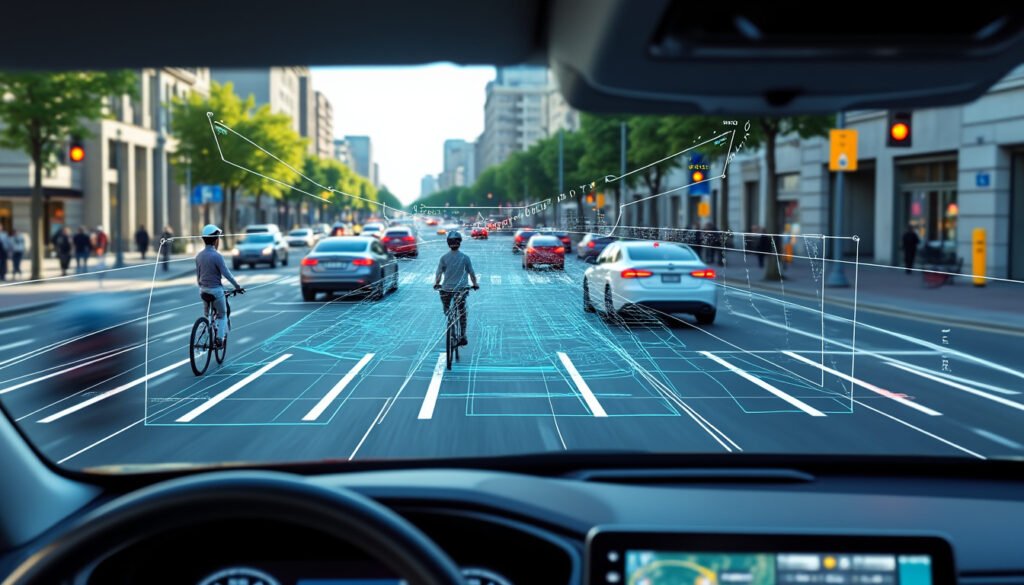
Advanced driver-assistance systems (ADAS) and autonomous vehicles are prime examples of edge computer vision’s necessity. Companies like Wayve are developing AI that learns from real-world visual data to navigate complex environments. These systems use embedded cameras to identify lane markings, pedestrians, and other vehicles, processing all data directly inside the vehicle. This on-board processing is essential for the split-second decisions required to ensure safety on the road.
The hardware foundation for edge intelligence
The rapid adoption of edge computer vision is intrinsically linked to advancements in hardware. The ability to run sophisticated deep learning models on small, power-efficient devices is no small feat. This progress is fueled by the development of specialized processors designed to accelerate AI computations. The models themselves are often developed and fine-tuned using specialized AI clouds before being optimized for deployment on these edge devices.
As the demand for more complex on-device intelligence grows, the market is seeing a corresponding rise of new AI chip challengers competing to create more powerful and efficient hardware. This ongoing innovation in silicon is a critical enabler of the edge revolution, promising to bring even more advanced computer vision capabilities to devices of all sizes in the near future.