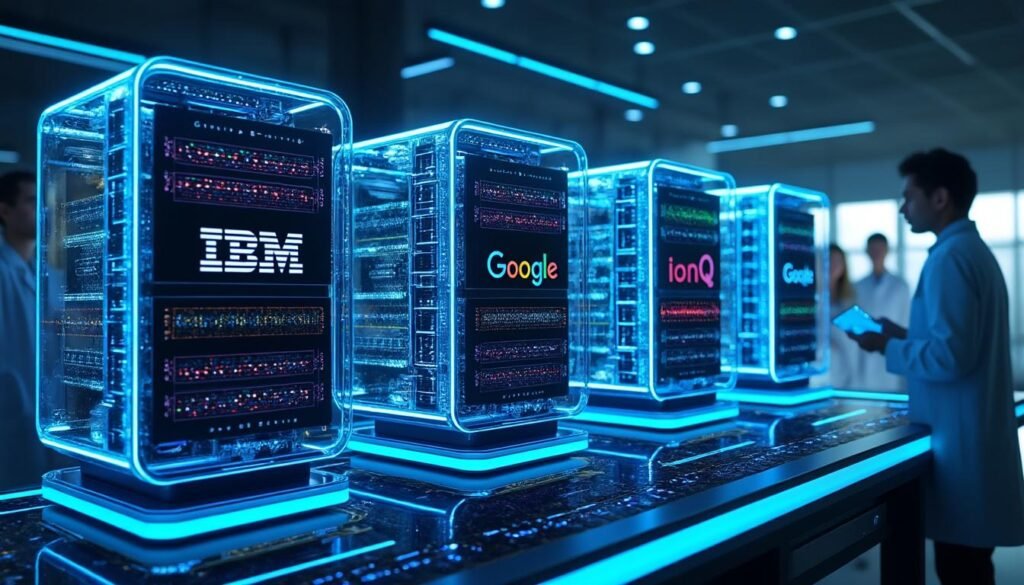


The term “quantum advantage” has transitioned from a theoretical milestone to a fiercely contested battleground for tech giants and startups. As of 2026, the conversation is no longer confined to academic circles; it’s about tangible, real-world applications that could redefine industries from materials science to finance. Claims of achieving this advantage—the point where a quantum computer definitively outperforms the best classical counterpart on a practical problem—are emerging with increasing frequency. Yet, each announcement is met with a mix of excitement and intense scrutiny from the scientific community. The central question has shifted from “if” to “how” and, more importantly, “how do we prove it?” This new era is defined not by a single, dramatic breakthrough, but by a painstaking process of hypothesis, validation, and collaboration. The challenge lies in separating genuine progress from marketing hype, as researchers navigate the complexities of noisy intermediate-scale quantum (NISQ) hardware, develop sophisticated error mitigation techniques, and work toward a community-wide consensus on what truly constitutes an undeniable advantage.
In Brief:
- Quantum advantage in 2026 is defined as a quantum system, often paired with a classical computer, solving a useful, real-world problem more efficiently, cheaply, or accurately than any classical method alone.
- The focus has shifted from theoretical “quantum supremacy” on abstract tasks to demonstrating practical utility with commercial or scientific relevance.
- Claims from companies like D-Wave and progress from IBM, Google, and others are rigorously tested by the scientific community, meaning advantage is a gradually accepted consensus, not a single event.
- Major technical hurdles remain, including qubit instability, environmental “noise,” and scalability. Progress hinges on advanced error mitigation and suppression techniques.
- Collaboration between hardware developers, software startups, and academic institutions is crucial for developing algorithms and benchmarks to validate performance claims.
Decoding quantum advantage in 2026
For years, the quantum computing world chased the concept of “quantum supremacy,” a demonstration that a quantum device could solve a problem no classical computer could feasibly tackle. Google’s 2019 claim was a landmark moment, but the focus has since undergone a critical evolution. Today, the more relevant and commercially significant goal is “practical quantum advantage.”
From supremacy to practical utility
Practical quantum advantage isn’t about solving an obscure, specially designed problem. It refers to the point where a quantum computer, working in tandem with classical resources, outperforms the best-known classical algorithms on a task with real-world value. This hybrid approach is often described as “quantum plus classical” beating “classical alone.” The goal is no longer just a proof of concept but a tool that delivers superior efficiency, cost-effectiveness, or accuracy for problems in fields like materials science, drug discovery, or complex optimization. This shift marks the transition of quantum computing from a purely scientific pursuit to a potentially transformative business tool.
The validation gauntlet
One of the defining characteristics of the current era is that no claim of quantum advantage is accepted at face value. Each assertion undergoes intense scrutiny from the global research community. When a team hypothesizes they have achieved an advantage, other experts immediately work to either support or falsify the result, often by developing new, more efficient classical algorithms to tackle the same problem. This rigorous, adversarial process ensures that progress is real and not just a product of clever marketing. It means that understanding what quantum advantage actually means is a continuous dialogue, and reaching a consensus is a slow and deliberate marathon, not a sprint.
The current landscape of quantum claims and contenders
The race toward quantum advantage is populated by a diverse ecosystem of established tech giants, specialized hardware companies, and agile software startups. Each is contributing a different piece to the puzzle, leading to a series of exciting, though often contested, milestones.
Key milestones and disputed victories
In 2025, D-Wave Systems announced it had achieved advantage on a real-world problem involving the simulation of magnetic materials, suggesting its Advantage2 quantum annealer solved the problem in minutes versus a classical computer’s projected million years. While met with some skepticism, the claim highlighted the potential of specialized quantum architectures. This follows a history of such announcements, each pushing the field forward even as they are debated. The back-and-forth is healthy, driving innovation on both the quantum and classical fronts as researchers refine their methods in response to new challenges.
IBM’s roadmap and collaborative efforts
IBM has pursued a clear, incremental path, focusing on building a robust ecosystem. Their roadmap aims to achieve verifiable advantage by demonstrating that their systems can perform reliable computations beyond the reach of brute-force classical simulation. A critical demonstration of this “quantum utility” involved using a 77-qubit Heron processor alongside the Fugaku supercomputer to simulate complex molecules. This approach highlights the power of quantum-centric supercomputing. Furthermore, IBM’s partners are leveraging their hardware to achieve notable results. Startups like Kipu Quantum and Q-CTRL are developing algorithms that show runtime advantages in optimization problems, directly addressing the key quantum milestones for 2026.
Overcoming the hurdles on the path to quantum reality
Despite the rapid progress, the journey to widespread, fault-tolerant quantum computing is fraught with fundamental technical challenges. Current machines are still in the Noisy Intermediate-Scale Quantum (NISQ) era, where environmental interference and hardware imperfections are significant obstacles.
The noise problem: Stability and errors
The foundational units of quantum computers, qubits, are incredibly fragile. Their quantum states can be easily disturbed by tiny fluctuations in temperature or electromagnetism, a phenomenon known as decoherence. This “noise” leads to errors in computation, such as bit-flips and phase-flips. As systems scale up in qubit count, maintaining stability and control becomes exponentially more difficult. A significant milestone was achieved in 2024 when Quantinuum announced a two-qubit gate fidelity above 99.9%, but the industry agrees that even higher fidelities are necessary for complex, large-scale algorithms.
The role of error mitigation and correction
Since perfect, error-free hardware is still a distant goal, the key to unlocking the power of NISQ-era machines lies in software. Error mitigation encompasses a suite of techniques that use classical post-processing to estimate and subtract the impact of noise from a quantum computer’s output. Startups are making huge contributions in this area:
- Algorithmiq’s Tensor Network Error Mitigation (TEM) manages noise in software, extending the reach of current quantum processing units.
- QEDMA’s technology combines error suppression at the hardware level with software mitigation to improve reliability.
- Companies like Riverlane are developing specialized operating systems to manage and correct errors in real-time.
These techniques are crucial for bridging the gap between today’s noisy hardware and the fault-tolerant systems of the future, making it possible to extract useful results even from imperfect machines.
What’s next? Building a consensus for a quantum future
Achieving quantum advantage is not the final destination but rather a critical marker on a much longer journey. The path forward requires not only better hardware and smarter algorithms but also a collaborative framework for the entire community to measure and validate progress.
The importance of open benchmarking
To move beyond disputed claims, the quantum community is recognizing the need to adopt a set of best practices. This includes establishing standardized benchmarking problems, developed with input from classical computing experts to ensure fairness and relevance. Transparently publishing detailed methodologies and datasets is also essential for reproducibility. Finally, open-access leaderboards can help track computational performance across different platforms and algorithms, fostering healthy competition and providing a clear measure of progress for the entire field. The work being done by various leading quantum computing providers is setting the stage for these standards.
Promising avenues for real-world impact
Among the most promising areas for achieving the first provable quantum advantages are problems that obey the variational principle, common in chemistry and materials science. Algorithms like Sample-Based Quantum Diagonalization (SQD) and Krylov Quantum Diagonalization (KQD) use a hybrid quantum-classical approach to find the lowest energy state of a molecule, a calculation that is incredibly difficult for classical computers. The beauty of these methods is that their results can be easily ranked and validated—if the quantum solution finds a lower energy state, it represents a tangible and verifiable advantage. These early successes are paving the way for breakthroughs that could accelerate the discovery of new medicines, catalysts, and advanced materials.
What is the difference between quantum supremacy and quantum advantage?
Quantum supremacy refers to a quantum computer performing a calculation that is practically impossible for any classical computer, even if the task has no real-world use. Quantum advantage, the more modern term, refers to a quantum computer outperforming the best classical computers on a useful, practical problem with commercial or scientific relevance.
Why are most quantum advantage claims disputed?
Claims are often disputed because the bar is constantly moving. When a quantum advantage is claimed for a specific problem, researchers in classical computing are often spurred to create new, more efficient classical algorithms to solve it. A true advantage must hold up against the best-known and future classical methods, and this requires rigorous, long-term validation from the scientific community.
Which industries are most likely to benefit first from quantum computing?
Industries dealing with complex simulation and optimization problems are expected to benefit first. This includes pharmaceuticals and materials science (for molecular simulation and drug discovery), finance (for portfolio optimization and risk analysis), and logistics (for solving complex scheduling problems).
Are today’s quantum computers fault-tolerant?
No, current quantum computers are in the Noisy Intermediate-Scale Quantum (NISQ) era. They lack the sufficient number of high-quality qubits and the robust quantum error correction codes needed for full fault tolerance. Researchers are currently relying on error mitigation techniques to extract useful results from these noisy systems while working toward building fault-tolerant hardware.