
The prevailing narrative often casts quantum computing and artificial intelligence as competitors in a race for technological dominance. This story suggests that AI, despite its power, is approaching its limits, and that quantum machines will emerge as its successor. However, the reality unfolding in research labs and high-tech firms is far less confrontational and vastly more collaborative. Instead of a rivalry, a powerful symbiosis is forming, where each technology addresses the weaknesses of the other. By 2026, it is clear that the future is not a choice between quantum and AI, but an integration of both within a sophisticated, hybrid computing architecture.
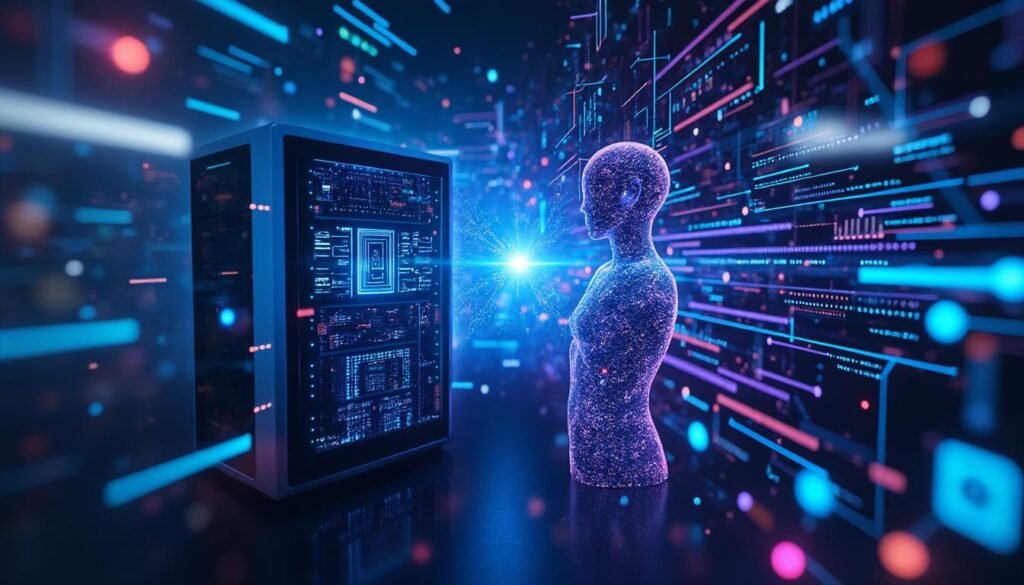
This evolving relationship is not based on one technology replacing the other, but on a strategic division of labor. AI has already become indispensable for making today’s noisy, intermediate-scale quantum (NISQ) computers functional. It provides the intelligent control layer needed to calibrate delicate hardware, design experiments, and mitigate the constant errors that plague quantum systems. In return, quantum computing offers a specialized toolkit to tackle specific, computationally intense problems within AI workflows—tasks like complex optimization and sampling that bog down even the most powerful classical supercomputers. This pragmatic partnership is paving the way for a new computing stack, where classical systems remain the foundation, AI acts as the smart orchestrator, and quantum processors serve as targeted accelerators for the hardest problems.
In brief
- Quantum computing and AI are developing as complementary technologies, not rivals. The future is a hybrid system where each plays a distinct role.
- AI is already crucial for making quantum computers viable by managing hardware calibration, error mitigation, and system optimization.
- Quantum computing is being explored to solve specific computational bottlenecks in AI, such as optimization and sampling, rather than to replace entire AI models like neural networks.
- The term “Quantum AI” refers to the intersection of these fields—using quantum for AI problems and AI to build better quantum systems—not a new form of quantum-native intelligence.
- The emerging architecture is hierarchical: classical computers form the base, AI provides an intelligent control layer, and quantum processors are used as specialized accelerators for suitable tasks.
Debunking the myth: why quantum computing isn’t replacing AI
The misconception that quantum computing will render artificial intelligence obsolete stems partly from the term “quantum AI,” which misleadingly suggests a new form of intelligence. In reality, modern AI systems, from large language models to neural networks, are fundamentally statistical engines built to find patterns in vast datasets. Their strength lies in approximation and learning from noisy, real-world information.
These tasks are exceptionally well-suited to classical hardware, particularly GPUs and other specialized accelerators, which handle the massive matrix multiplications at the core of deep learning with incredible efficiency. Quantum computers, by contrast, do not inherently perform these statistical tasks better. Their power lies in a completely different computational paradigm, one based on superposition and entanglement. They offer a new toolkit, but it’s one designed for a very different class of problems, not a blanket upgrade for existing AI workloads.
For the foreseeable future, classical computing will remain the fastest, most reliable, and cost-effective option for the vast majority of AI applications. The idea of a quantum computer “running” a neural network faster by default is a fundamental misunderstanding of what each technology is built to do.
The true relationship: a two-way street of enablement
Rather than a competition, the relationship between quantum and AI is a symbiotic one. Each field is providing critical tools that accelerate progress in the other, creating a feedback loop that pushes the boundaries of what’s possible. This two-way street is the most accurate way to view their interaction in the current technological landscape.
On one side, AI is providing the “smarts” to tame the immense complexity of building and operating quantum hardware. On the other, quantum computing offers a potential escape hatch for AI from the computational bottlenecks that even classical supercomputers struggle to overcome. This interdependence defines the practical path forward.
How AI is accelerating the path to quantum viability
Quantum computers are notoriously fragile and difficult to control. Their quantum bits, or qubits, are highly susceptible to environmental noise, leading to errors that can derail computations. Managing these systems requires a level of precision and continuous adjustment that is often beyond human capability.
This is where machine learning has become an essential enabler. AI algorithms are now routinely used for several critical functions in quantum computing:
- Hardware Calibration: AI models can automatically tune the control pulses and physical parameters needed to keep qubits stable and performing correctly.
- Error Mitigation: Neural networks are being trained to recognize and correct for errors in quantum measurements, improving the reliability of results from today’s NISQ machines.
- Experiment Design: Reinforcement learning can discover new and more efficient experimental protocols that human physicists might not have conceived.
- Compiler Optimization: AI helps translate high-level quantum algorithms into the low-level instructions a specific quantum device can execute, optimizing the process to reduce errors.
Without these artificial intelligence for quantum computing tools, the process of scaling up quantum systems would be significantly slower and more arduous. In essence, AI is serving as the intelligent operating system for nascent quantum hardware.
Where quantum computing provides a targeted boost for AI
While AI is a broad field, certain problems within it are incredibly difficult to solve classically because the number of possibilities grows exponentially. These computational bottlenecks are where quantum computing could provide a significant advantage, not by replacing AI systems wholesale, but by accelerating specific, high-value subroutines.
Research is focused on a few key areas. Combinatorial optimization, which involves finding the best solution from a massive number of possibilities, is a prime example. This applies to real-world challenges in logistics, such as vehicle routing, and in finance, for portfolio optimization. Another area is high-dimensional sampling for probabilistic models, which is crucial in fields like drug discovery. The question of whether true quantum advantage is real for these applications is still being tested, but the potential is enormous.
Quantum-assisted reinforcement learning is also being explored for training AI agents in environments with vast state spaces, such as in materials science or autonomous systems. In these scenarios, the quantum processor handles the computationally intensive search or sampling task, feeding the result back into a larger classical AI pipeline. This targeted approach promises to lower training costs and enable more stable and efficient learning.
Visualizing the future: the emerging hybrid compute stack
The most likely future for advanced computing is not a complete switch to quantum but the development of a hybrid, hierarchical architecture. This model mirrors previous shifts in computing, such as when GPUs were introduced not to replace CPUs but to accelerate specific graphical and parallel workloads alongside them.
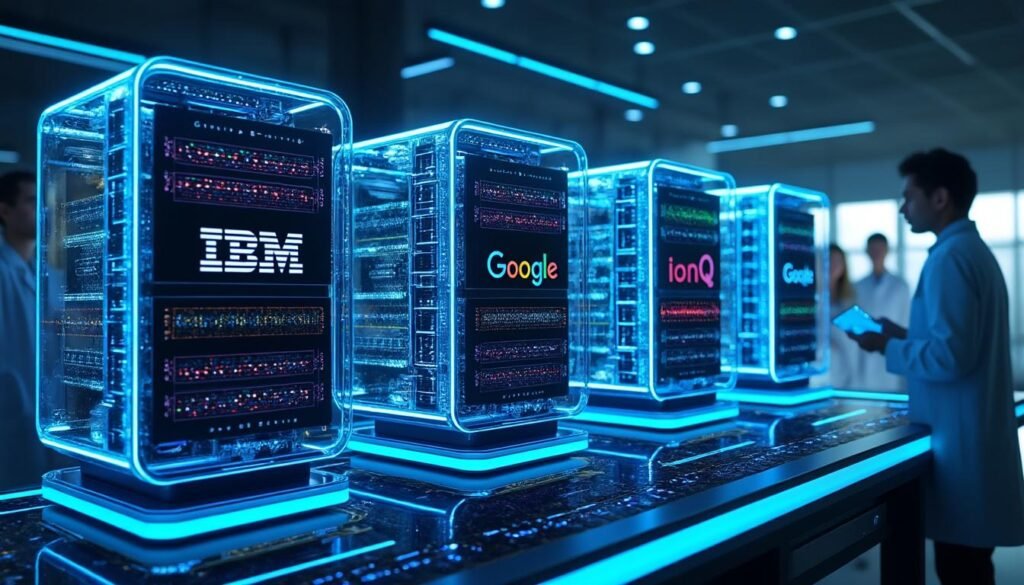
In this emerging stack, classical computing remains the foundation, running the operating system, managing data, and executing the bulk of AI workloads. AI models themselves act as a higher-level orchestration layer, managing complexity and deciding when to offload a specific task. At the top of this hierarchy, quantum processors like those from leading quantum computing companies are treated as specialized co-processors or accelerators. An AI orchestrator would identify a problem, such as a complex optimization task, that is well-suited for a quantum approach and send it to the quantum processing unit (QPU).
This integration of artificial intelligence and quantum computing allows each component to do what it does best. For businesses, this means that quantum computing is unlikely to disrupt most AI products in the immediate term. However, in sectors like finance, logistics, and materials science, it could fundamentally reshape cost structures and capabilities. Enterprises that ignore this shift risk being at a significant disadvantage when quantum-accelerated solutions become commercially viable.
Will quantum computers replace AI and machine learning systems?
No. Researchers widely agree that quantum computing and AI are complementary technologies, not rivals. Quantum computers are not designed to run traditional AI tasks like neural networks faster by default; they excel at different types of problems.
How is AI already being used to improve quantum computers?
Machine learning is a core tool used to manage the complexity of quantum hardware. It helps with designing experiments, calibrating sensitive components, optimizing control signals, and mitigating the errors that are common in today’s quantum systems.
What specific AI problems could quantum computing help solve?
Quantum computing shows the most promise for addressing computational bottlenecks within larger AI workflows. These include combinatorial optimization (e.g., logistics planning), high-dimensional sampling (e.g., drug discovery), and reinforcement learning in complex environments.
What does the term ‘quantum AI’ actually mean?
Quantum AI is not a new form of intelligence. It is a field of research focused on two things: 1) using quantum computers to solve hard computational problems found in AI, and 2) using AI techniques to help design and operate better quantum computers.
What will the future computing architecture that combines quantum and AI look like?
The consensus points toward a hybrid and hierarchical architecture. Classical computers (CPUs) will remain the foundation, with GPUs accelerating many AI tasks. Quantum processors (QPUs) will be integrated as specialized accelerators for very specific types of problems, with AI systems often orchestrating the workflow between them.