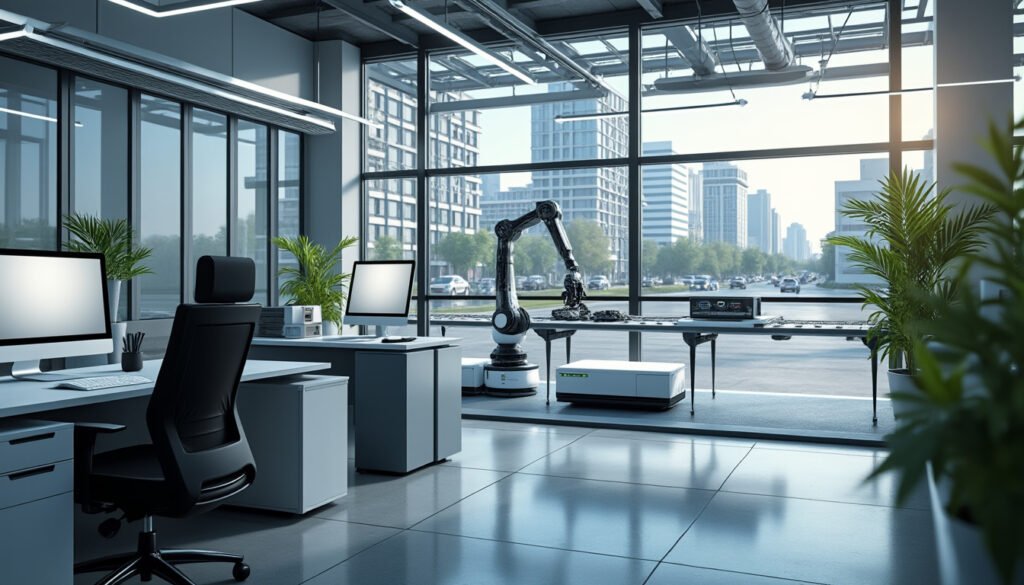


The conversation around artificial intelligence has decisively shifted. What began as a discussion about generative models and chatbots has evolved into the practical deployment of autonomous AI agents. By 2026, these agents are no longer a futuristic concept; they are being integrated into corporate structures, performing complex workflows, and fundamentally altering the landscape of knowledge work. This transition is not about replacing human workers wholesale, but about redefining roles and demanding a new set of collaborative skills.
Companies are moving beyond pilot programs to full-scale implementation. From handling initial candidate screening in human resources to managing entire customer service ticket lifecycles, AI agents are now treated as digital employees. This rapid adoption raises critical questions for professionals across all sectors: What does this mean for daily responsibilities, and how can one prepare for a future where collaboration with AI is not just an option, but a necessity?
The new reality of AI agents in the professional world
The hype that once surrounded generative AI has now materialized into tangible, goal-driven applications. Autonomous agents are executing tasks that require planning, reasoning, and the use of various digital tools, all with minimal human oversight. This capability moves them far beyond the scope of simple chatbots or assistants that require constant prompting. A user can assign a high-level objective, and the agent can devise and execute the necessary steps to achieve it.
Major technology companies and innovative startups alike are pushing the boundaries of what these agents can do. For instance, some firms are already experimenting with “zero-FTE departments” where AI agents manage entire operational functions, with human staff shifting to oversight and strategy roles. A travel company might deploy an AI concierge that not only suggests activities but also handles bookings and logistics in real time. This is a clear indicator that the mainstream adoption of autonomous AI is redefining work as we know it.
How AI agents are transforming key business functions
The impact of AI agents is not uniform; it manifests differently across various departments. In human resources, agents now screen thousands of applications for frontline positions, freeing up recruiters to focus on interviews and candidate engagement. They can also handle the onboarding process, from paperwork to initial training modules, ensuring a consistent experience for new hires.
In customer service, AI handles routine inquiries and resolves common issues from start to finish. This allows human agents to dedicate their time to complex, high-stakes situations that require empathy and nuanced problem-solving. Rather than being replaced, the human role is elevated to that of a specialist for critical incidents. This shift requires a fundamental change in how performance is measured, moving from ticket volume to customer satisfaction in complex cases.
Developing the essential skills for an AI-augmented workplace
As AI agents take over repetitive and process-driven tasks, the value of uniquely human skills has never been higher. The ability to navigate ambiguity, exercise critical judgment, and build trust in high-stakes interactions are qualities that current AI cannot replicate. A recent McKinsey report highlighted that even younger generations prefer human interaction for important customer service issues, underscoring the continued need for empathy and creativity.
Professionals must therefore focus on evolving their skill sets. This involves not only honing interpersonal abilities but also developing a new kind of technical literacy. Learning to work with AI agents as colleagues is paramount. This includes understanding how to give clear instructions—a practice often called prompt engineering—and knowing when to trust an agent’s output versus when to intervene. The most successful professionals will be those who can bridge the gap between human teams and their new digital counterparts.
The strategic imperative of AI readiness
For organizations, simply acquiring AI technology is not enough. Without a clear strategy and a robust governance framework, these powerful tools can lead to inefficiencies or even significant risks. A common pitfall is the failure to prepare employees for the change, leading to mistrust and duplicated work as staff members manually verify tasks completed by AI. Technology cannot be held responsible for its actions; a human within the organization will always be accountable.
A successful transition requires a commitment to what some experts at IBM call an AI-ready enterprise. This means preparing an organization’s data infrastructure so that agents can access and utilize proprietary information effectively. It also involves establishing clear guidelines for transparency and traceability, ensuring every action taken by an agent can be monitored and audited. Ultimately, the goal is to use AI to augment human capabilities, freeing people to focus on more strategic and innovative work.
A practical comparison of roles before and after AI agents
The integration of AI agents is not about eliminating jobs but transforming them. The following table illustrates how responsibilities are shifting within several key professional roles, moving from manual execution to strategic oversight and collaboration.
| Role | Traditional Responsibilities (Pre-AI Agent) | Evolved Responsibilities (Post-AI Agent) |
|---|---|---|
| HR Recruiter | Manually screening resumes, scheduling initial interviews, handling onboarding paperwork. | Designing AI screening parameters, conducting final-round interviews, developing human-AI team integration strategies. |
| Customer Support Agent | Answering high volumes of repetitive queries, escalating complex tickets. | Managing complex and emotionally charged customer issues, training AI on new problem-solving protocols, analyzing AI performance data. |
| Sales Development Rep | Lead qualification, sending initial outreach emails, scheduling demos. | Building relationships with high-value leads identified by AI, handling complex negotiations, and closing strategic deals. |
| IT Help Desk Technician | Resolving common software issues, managing user access, password resets. | Overseeing AI-managed help desk, handling system-wide incidents, improving automation workflows, and exploring new uses for AI in other organizational areas. |
Will an AI agent take my job?
It is more likely that AI agents will change your job rather than eliminate it. They are designed to automate repetitive, process-driven tasks, which allows human workers to focus on more strategic, creative, and complex problem-solving that requires emotional intelligence and critical judgment. The key is to adapt by developing skills that complement what AI can do.
What is the difference between an AI agent and a chatbot like ChatGPT?
A chatbot responds to individual prompts and requires continuous human input for each step of a task. An AI agent is autonomous. You can give it a high-level goal, and it can independently plan and execute a series of actions, use tools, and interact with different systems to achieve that goal without step-by-step instructions.
What is the most important skill to learn for the age of AI agents?
While technical literacy is important, the most crucial skills are uniquely human: emotional intelligence, creative problem-solving, critical thinking, and the ability to build trust. Since AI will handle routine tasks, your value will come from managing ambiguity, leading teams through change, and handling situations that require nuanced human judgment.
How can I start preparing for this change today?
Begin by experimenting with available AI tools in your daily work to understand their capabilities and limitations. Practice giving clear and effective instructions (prompt engineering). Identify parts of your job that could be automated and proactively take on projects that require the ‘human edge’ skills, such as complex negotiation or team leadership.