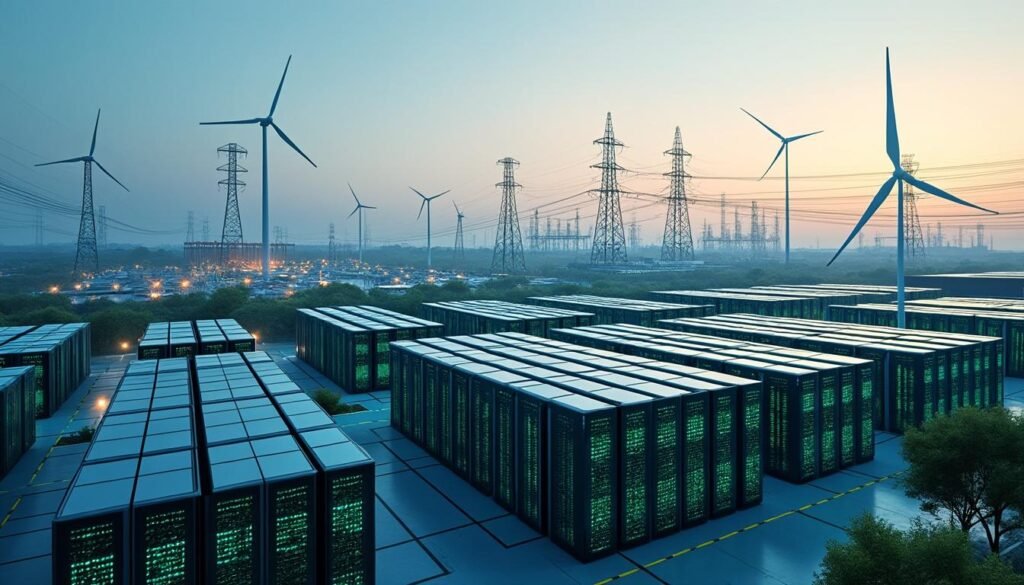


The tech industry’s AI race often seems like a high-stakes poker game where the biggest pile of chips wins. The prevailing logic is simple: more data centers equal more compute power, which enables superior AI products, ultimately leading to market domination. But as the titans—Microsoft, Google, Meta, and Amazon—shove hundreds of billions of dollars onto the table, the game is proving to be far more complex than just a spending contest. While the public marvels at the latest AI models, the real war is being fought in the trenches of infrastructure, a brutal, expensive battle over power, cooling, and the fundamental physics of computation. The quarterly earnings reports of 2026 have peeled back the curtain, revealing a frantic arms race where the numbers are staggering, investor confidence is wavering, and the true winners might not be the ones with the biggest budgets, but the ones with the smartest solutions to the existential bottlenecks threatening to throttle the entire industry.
This isn’t just about building more servers; it’s a desperate scramble for the resources to power and cool them. Satya Nadella himself admitted in late 2025 that power availability has become a more significant constraint than chip supply. With some data center projects facing a seven-year wait just to connect to the grid, the problem is existential. This frantic build-out has massive implications, and the AI race is heating up in 2026 in ways few anticipated. The companies that can master the intricate dance of energy management and thermal dynamics will not only lead the decade but define its technological landscape. Those who can’t will be left with billions in overheated, underpowered hardware—monuments to a flawed strategy.
The Capex Tsunami: A $500 Billion Bet
If the AI war is a spending game, then Amazon appears to be going all-in. The company’s projections for 2026 indicate a colossal $200 billion in capital expenditures, a significant jump from $131.8 billion in 2025. While this figure covers a range of ventures, including robotics and satellites, a massive portion is earmarked for AI infrastructure. Google is hot on its heels, projecting a capex between $175 billion and $185 billion, up from $91.4 billion the previous year. Microsoft, despite recent investor pressure on CEO Satya Nadella, is on track for roughly $150 billion. Meta trails slightly, with a projected spend of $115 billion to $135 billion for 2026.
The logic from Silicon Valley is straightforward: high-end compute is the new oil, and only those who control the supply will survive the coming AI revolution. But Wall Street isn’t entirely sold. As these tech giants announced their multi-hundred-billion-dollar commitments, each saw their stock price take a hit. Investors are balking at the sheer scale of the spending, especially when the revenue directly tied to these AI investments remains a question mark for some. As earnings reports reveal the winners and losers, it’s clear the market is rewarding proven AI payoffs, not just ambitious spending.
Power and Cooling: The Real AI Bottleneck
The mountain of cash being spent on servers is meaningless without a solution to two fundamental problems: power and cooling. By the end of 2025, AI workloads were already consuming nearly half of all data center power, a figure that had doubled in just 18 months. Traditional air cooling systems simply can’t keep up with the intense heat generated by modern GPUs, which can produce three to five times more heat than the CPUs that ran the last generation of data centers.
This has forced a radical shift in design. Today, 73% of new AI-optimized facilities are deploying advanced direct-to-chip or immersion liquid cooling systems. The market for liquid cooling alone is projected to hit $17.8 billion by 2027. This isn’t an incremental upgrade; it’s a necessary evolution. If you can’t cool your infrastructure, you can’t run AI workloads. If you can’t run AI workloads, your half-trillion-dollar investment generates zero revenue. This massive energy consumption also raises serious questions about whether AI is making the climate crisis worse.
The Patent War: Uncovering the Hidden Leaders
A deep dive into 3,279 patents filed between 2020 and 2025 for data center cooling and power management reveals a surprising landscape. The companies making the most noise aren’t necessarily the ones creating the most valuable intellectual property. The data uncovers three major surprises that challenge the conventional narrative of the AI infrastructure race.
First, Baidu is the undisputed king of cooling patents, with 287 filings. That’s more than Google, Microsoft, and Amazon combined. The Chinese tech giant isn’t just building data centers; it’s constructing a formidable IP moat around the technology required to run them efficiently at scale. Second, Microsoft’s patent activity is shockingly low. Despite committing over $100 billion to data centers, the company filed only 12 power management patents in the last five years, suggesting a strategy heavily reliant on licensing or commodity technology. Third, traditional hardware vendors are reinventing themselves as IP powerhouses. Dell leads in power management patents, while Nvidia is in the top three for cooling, positioning both as critical architects of the AI future, not just suppliers.
US vs. China: A Tale of Two Philosophies
The patent data also reveals a stark divergence in strategy between the US and China. Chinese firms, including Baidu, Alibaba, and Tencent, have filed over 600 patents focused on cost reduction, manufacturing scale, and energy efficiency. Their innovations center on modular liquid cooling systems and high-density rack designs, aiming to win through hyperscale volume and operational efficiency.
In contrast, US companies like Google, Nvidia, and Intel are concentrating on AI-specific optimization. Their 400+ patents focus on sophisticated techniques like dynamic power allocation for GPU clusters and predictive thermal management using machine learning. A prime example is Google’s patent for “energy-aware workload placement,” which uses AI to predict the power consumption of incoming jobs and route them to servers with the most thermal headroom, reducing total power use by 15-20%. It’s a fascinating split: China is mastering the hardware of cooling, while the US is pioneering the use of AI to cool AI.
The Breakthroughs Defining Next-Gen Data Centers
This intense competition is fueling a wave of innovation that is fundamentally reshaping what a data center is. Three key technological breakthroughs stand out as game-changers for the AI decade.
- Liquid Cooling Becomes Standard: Traditional air cooling maxes out at around 15kW per rack. To handle the 100kW+ densities of AI workloads, liquid cooling is now mandatory. Nvidia’s patent for an “intelligent radiator-assisted power and coolant distribution unit” integrates both systems, reducing a data center’s footprint by 30% and enabling double the rack density.
- AI-Driven Workload Placement: The most efficient watt is the one you never use. Instead of just building bigger cooling systems, companies are using AI to reduce cooling needs. IBM’s patent for “energy-aware workload placement” uses real-time thermal monitoring and ML predictions to route jobs to the most thermally optimal nodes, cutting power consumption significantly without sacrificing compute capacity.
- Power Smoothing for GPU Clusters: AI training creates massive, periodic power spikes that can destabilize the electrical grid. A recent Microsoft patent details a “thermo-mechanical power smoothing” system. It uses the thermal mass of the cooling system to absorb and release energy, smoothing out the power draw from the grid. It’s a brilliant solution that shows a deep understanding of the unique challenges posed by AI workloads.
So, who is actually winning the AI race right now?
It’s not a single race but several. In terms of pure spending, Amazon and Google are leading the pack. However, when it comes to the critical infrastructure IP for cooling, Baidu has a surprising and dominant lead. Meanwhile, companies like Nvidia and Dell are becoming indispensable enablers by creating the core intellectual property for both cooling and power management. There is no single winner, but a complex ecosystem of competitors and collaborators.
Why is Microsoft spending so much if it isn’t filing many infrastructure patents?
Microsoft’s low patent count in power management suggests a different strategy. The company is likely licensing critical technology from partners, relying on the innovations of vendors like Nvidia and Dell, or focusing its internal R&D on the software and cloud service layers rather than the underlying hardware. They are betting on being the best at integrating and operating the infrastructure, rather than inventing every component themselves.
Is all this spending on AI data centers sustainable?
That is the hundred-billion-dollar question. Investors are already showing signs of nervousness about the immense capital expenditures. Furthermore, the environmental impact of this massive power consumption is a growing concern. The long-term sustainability will depend on a shift from brute-force spending to efficiency. This is why the breakthroughs in AI-driven power and cooling management are so critical—they represent the path to a more sustainable and profitable future for the AI industry.