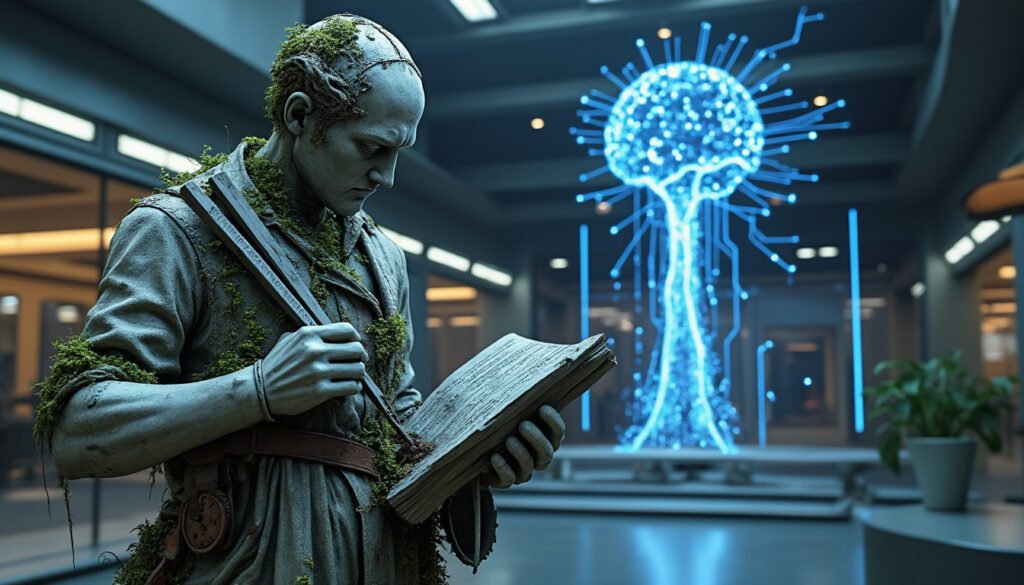


Artificial intelligence has evolved far beyond its text-only origins. The most significant leap forward is the rise of multimodal AI models, systems capable of processing and understanding different kinds of data at once. These platforms can analyze text, audio, images, and video simultaneously, mirroring human-like comprehension in a way that was previously confined to science fiction.
Unlike the early generations of AI, which were limited to single, siloed tasks, multimodal systems integrate multiple data streams into a single, unified understanding. This capability is not just an incremental improvement; it represents a fundamental shift in how we interact with technology, collapsing entire workflows into simple, conversational interfaces.
Defining the Multimodal AI Revolution
The term “multimodal” simply refers to the use of multiple modes, or types, of information. In the context of artificial intelligence, a modality is a specific format of data, such as text, images, audio, video, or even code. While traditional AI models were unimodal—a language model only processed text, and an image recognition model only analyzed pictures—today’s advanced systems operate very differently.
A multimodal AI integrates these distinct data formats within a unified architecture. It doesn’t just handle them sequentially; it reasons across them. This allows the model to “see” through computer vision, “hear” using speech recognition, and “read” via natural language understanding, merging these inputs to form a cohesive and context-rich interpretation of a query.
How these systems generate cross-modal insights
The true power of these models lies in their ability to not only process but also generate content across different modalities. Top-tier systems like OpenAI’s GPT-4o and Google’s Gemini can produce images from a text prompt, speak their responses aloud, or even create short video clips. This cross-modal capability collapses the gap between narrow AI and more holistic, human-like reasoning.
This integration of sight and language is particularly transformative. As discussed in recent analyses, vision-language models have fundamentally altered the field of computer vision, moving it from simple object detection to nuanced scene interpretation. This is achieved by training the models on vast datasets where images and their corresponding text descriptions are linked, teaching the AI to connect visual patterns with semantic meaning.
The Practical Impact of AI That Sees and Hears
The real-world implications of multimodal AI are already vast and continue to grow. By enabling machines to understand the world in a more human-centric way, these technologies are enriching human-computer interaction, improving accessibility tools, and streamlining complex professional workflows. Industries are now rethinking processes that once required multiple specialized tools and personnel.
For example, in enterprise automation, these models can process an invoice that includes a company logo (image), line items (text), and a recorded voice note from an account manager (audio). A unimodal system would require three separate AIs to handle this, but a multimodal system comprehends it all in one pass. This quiet revolution is changing everything about how businesses operate.
| Task | Unimodal Workflow (Legacy) | Multimodal Workflow (Current) |
|---|---|---|
| Medical Scan Analysis | Radiologist reviews image, dictates a report, a separate tool transcribes the audio. | AI analyzes the scan (image), the patient’s history (text), and the doctor’s spoken notes (audio) to provide a unified diagnostic suggestion. |
| Content Creation | A writer creates a script, a designer finds stock images, and a video editor assembles the assets. | A single prompt is given to an AI, which generates the script, creates relevant imagery, and produces a narrated video. |
| Customer Support | A chatbot handles text queries, while an IVR system handles phone calls. A user must switch channels for complex issues. | An AI agent assists a customer via video call, analyzing their screen share, understanding their speech, and referencing text-based help documents in real-time. |
Transforming enterprise and creative workflows
The ability to combine vision and language to automate document processing is one of the most immediate benefits for businesses. Multimodal LLMs can now ingest, understand, and extract information from complex documents containing charts, tables, and text, a task that was previously labor-intensive and error-prone.
From autonomous vehicles that interpret road signs and pedestrian gestures to personalized education tools that adapt to a student’s learning style, the applications are expanding rapidly. The development of these powerful systems is a frequent topic in our weekly roundups of major AI news, as new breakthroughs are announced regularly.
Why This Reshapes the Future of AI Development
The shift toward multimodality is forcing a necessary evolution in the AI research community. The evaluation benchmarks, training pipelines, and safety frameworks that were built for unimodal systems must now be urgently revisited and, in many cases, rebuilt from scratch. Reasoning across different data types introduces new complexities and potential failure points that require novel solutions.
For developers and researchers, this presents both a challenge and an opportunity. The goal is no longer just about creating a model that excels at a single task but about building integrated systems that demonstrate a more generalized and robust understanding of the world. This pursuit of a more unified intelligence is pushing the boundaries of what machines can achieve.