
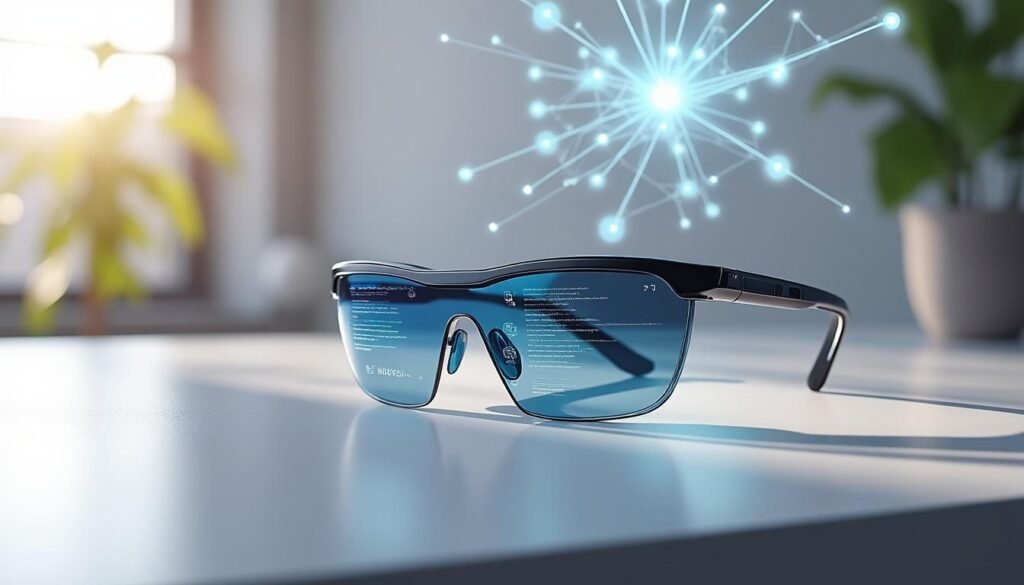

For over a decade, the dream of augmented reality has been just that—a dream, tantalizingly close yet always out of reach. We’ve been tethered to our smartphones, powerful portals that paradoxically disconnect us from the world by forcing our gaze downward. Early attempts at smart glasses, like the infamous Google Glass, stumbled, becoming symbols of social awkwardness and technological overreach. The promise of seamlessly blending digital information with our physical reality remained unfulfilled, bogged down by bulky designs, inadequate power, and a user experience that felt more like a beta test than a revolution.
This persistent gap between sci-fi vision and real-world execution created a landscape of skepticism. Each new prototype was met with a familiar cycle of hype and disappointment, leaving us to wonder if true AR glasses would ever be more than a niche gadget for enthusiasts. Now, a prototype codenamed Orion has emerged from Meta’s Reality Labs. It isn’t just another iteration; it represents a potential tipping point, a convergence of design, AI, and silicon innovation that could finally deliver on the long-held promise of intuitive, pervasive augmented reality.
The Silicon Heart of Orion’s Revolution
What sets Orion apart from its predecessors isn’t just a sleeker design, but the computational horsepower packed into its deceptively normal-looking frame. The fundamental challenge for true AR has always been a battle against physics: how to deliver massive processing power for real-time graphics and AI without requiring a heavy battery pack or turning the device into a personal face-heater. The answer lies in a custom-designed System-on-a-Chip (SoC) that represents a monumental leap in wearable technology.
This isn’t an off-the-shelf mobile processor. Meta has engineered a bespoke piece of silicon optimized for a single purpose: low-latency, high-efficiency AR. It integrates a powerful CPU, a specialized GPU for rendering holographic displays, and, most critically, a dedicated Neural Processing Unit (NPU). This NPU is the engine for the onboard AI, handling tasks from voice recognition to real-time object identification without a constant, battery-draining connection to the cloud. This breakthrough in brain-powered true AR is what allows Orion to feel less like a computer on your face and more like an extension of your senses.
A New Paradigm for Human-Computer Interaction
Orion’s potential lies in its ability to shift our primary mode of interaction from a touchscreen to the world itself. The onboard AI, powered by its custom chip, is designed to understand context. Imagine looking at a foreign menu and seeing it instantly translated, or glancing at a historic building and having key information subtly overlaid in your field of vision. This is achieved through a combination of advanced optics and AI-driven software that finally seems to be catching up with the hardware.
The device aims to deliver on several key futuristic applications:
- Live Translation: Converse with someone speaking a different language, with subtitles appearing discreetly in your view.
- Contextual AI Assistant: Ask questions about what you’re seeing, and get answers without pulling out your phone.
- Holographic Communication: Engage in more immersive video calls where avatars of friends and colleagues appear in your physical space.
- Seamless Navigation: Follow directional arrows that appear to be painted on the real-world streets in front of you.
This level of integration suggests a future where the barrier between digital and physical information begins to dissolve entirely, making technology an ambient, helpful presence rather than a demanding distraction.
Overcoming the Shadow of Google Glass
No discussion of smart glasses can ignore the cautionary tale of Google Glass. Its failure was as much social as it was technological. The prominent camera and overtly “techy” design made people uncomfortable, earning its users the moniker “Glassholes.” Meta appears to have learned this lesson well. The Orion prototypes, while still thicker than standard spectacles, prioritize a socially acceptable form factor. The design philosophy is clear: the best technology is invisible.
By mimicking the look of regular eyewear, Meta aims to remove the social friction that plagued earlier devices. The goal is for the wearer to blend in, allowing the technology to augment their reality without alienating those around them. This focus on aesthetics and social discretion is a critical component of the strategy to finally push smart glasses into the mainstream.
A New Frontier for Creatives and a Challenge for Regulators
The implications of a device like Orion extend far beyond simple convenience. For artists, designers, and developers, it represents an entirely new medium. The ability to create and share persistent holographic content could transform everything from interior design and gaming to education and remote collaboration. The disruptive opportunities for creatives are immense, offering a blank canvas painted directly onto the world.
However, this powerful technology also brings significant privacy concerns to the forefront. A device that is always on, always seeing, and always connected raises profound questions about data collection, consent, and surveillance. The debate over how to regulate such technology is only just beginning, and finding the right balance between innovation and privacy will be one of the defining challenges of the coming decade.
How Orion Stacks Up Against the Coming Competition
Meta is not alone in this race. While Orion is currently the most advanced prototype demonstrated, other tech giants are undoubtedly working on their own solutions. Apple, having established a foothold in spatial computing with its Vision Pro line, is a formidable future competitor. A device that shrinks the power of a spatial computer into a glasses form factor is the logical next step, and understanding the evolution of the Apple Vision Pro 2 provides clues to where the industry is heading.
The competition will ultimately be fought on multiple fronts: processing power, battery life, display quality, app ecosystem, and, perhaps most importantly, design and social acceptance. Orion’s early reveal gives Meta a head start in the narrative, but the race to define the future of personal computing is far from over.
When will Meta’s Orion glasses be released to the public?
Currently, Orion is a highly advanced prototype available only to Meta employees and select partners. There is no official public release date, but industry speculation points to a potential consumer launch within the next few years, likely after further refinement and development.
What makes Orion different from previous smart glasses like Google Glass?
The key differences are in technology and design philosophy. Orion uses far more advanced custom silicon for powerful onboard AI and holographic displays, enabling true augmented reality rather than just a heads-up display. Critically, its design aims to look like a normal pair of glasses to overcome the social acceptance issues that plagued Google Glass.
Will Orion need to be connected to a smartphone to work?
While details are still emerging, the goal for Orion is to be a standalone device. Its powerful, custom-built processor is designed to handle most AI and AR tasks directly on the glasses, reducing reliance on a tethered smartphone for core functions and making the experience more seamless.
What are the biggest privacy concerns with the Orion glasses?
The primary concerns revolve around the always-on camera and sensors. This raises questions about constant data collection, the potential for surveillance (both by the company and other users), and how to ensure the privacy of people in the wearer’s vicinity who are being recorded without their explicit consent.